
I was coming home from a day of cross-country skiing when I got the news that Bob Weir had died. Weir and the Grateful Dead had been a part of my life since I saw my first Dead show, in Oakland on December 26, 1980. A teenager from the sheltered suburbs south of San Francisco, I was astounded by what I saw and heard that night: spontaneous music that had no bounds, enthralled fans who made it clear their love for the band would not fade away.
It wasn’t like I felt that I’d found my people. I was a bit scared by the scene: the ecstatic twirlers who evoked Sufi whirling dervishes, the followers who’d tripped too hard and who the four winds hadn’t blown safely home. Across the street from the Oakland Auditorium, a tent and van camp had sprung up outside where Deadheads from all over North America slept away the day, some emerging like bats at dusk, a couple of hours before showtime.
Still, I sensed the magic and couldn’t wait to come back. Two nights later, I attended my second Dead show. And when I was in a record store called the Wherehouse and heard the Dead had released a few more tickets for New Year’s Eve, I snapped up the maximum (four) at the BASS Ticketron outlet in the store.
On New Year’s Eve, concert impresario Bill Graham, dressed in a flowing blue robe and long white beard, appeared just before midnight as Father Time. He moved toward the stage atop a giant skull and tossed roses into the crowd as he counted down the seconds to the new year. Hundreds of balloons cascaded down from the rafters as the Dead launched into “Sugar Magnolia.”
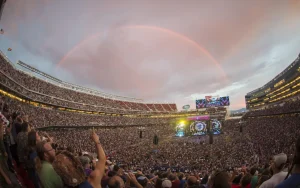
Rainbow at one of the Dead’s 50th anniversary shows in Santa Clara in 2015. (AP)
Over the years, I began to appreciate how the Dead evoked the natural world in their music, and not just with their lyrics. The story below mentions just some of these songs — there are many more. One friend wrote: “You did miss one of my favorite all-time Dead lyrics. “Come hear Uncle John’s band, Playing to the tide.” I always loved the image of a band playing for the tide—no other audience at all, just the tide, the universe, a greater power.”
As a proud cat owner, I very much wanted to write about songs such as the Dead’s “China Cat Sunflower,” with the line “Comic book colors on a violin river and Garcia’s “Cats Under the Stars.”
The Grateful Dead provided the soundtrack for so many outdoor adventures: roadtrips in the 1980s and ’90s to visit national parks or to reach whitewater rivers for rafting escapades required a briefcase-size carrier full of cassettes of favorite shows. Some called these bootlegs, but members of the Dead often said they were happy to share the music and had sections at their concert for tapers. As lead guitarist Jerry Garcia said of the band’s shows: When we’re done with it, they (the fans) can have it. (This is paraphrasing Lesh quoting Garcia.)
When pitching a story idea to a magazine, it’s best to answer three essential questions: Why now? Why this magazine? And why me? When I pitched my editor at Sierra, I mentioned that a story about the Dead and nature was timely due to Weir’s passing, that it fit the magazine’s mission of appreciating and preserving the natural world, and that I was conversant with the band’s song catalog. The clincher: it wasn’t a story I’d seen anywhere else.
Beyond celebrations of the wonders of nature, the Dead’s music demands we pay attention to what humans are doing to the planet. Yet these songs aren’t dour and don’t lecture. They wake us up to the transcendent beauty of the planet.
Below is an excerpt from my story; click here to read the full story on Sierra magazine’s site.
Songs such as “Weather Report Suite” evoke America’s agricultural heritage during a time when staying in tune with the seasons could mean the difference between hunger and abundance. Part II of the suite, “Let It Grow,” has this verse: “Round and round, the cut of the plow in the furrowed field / Seasons round, the bushels of corn and the barley meal / Broken ground, open and beckoning / to the spring, black dirt live again.”
“Weather Report” goes beyond appreciating Earth’s offerings, said David Dodd, author of The Complete Annotated Grateful Dead Lyrics. “That’s the big song for me,” he said, because it speaks to “the divinity of the planet itself.”
Co-writer Barlow was a biblical scholar, and the line, “Listen to the thunder shouting, ‘I am, I Am, I AM!’” is an invocation of Yahweh, the Hebrew name of God in the Old Testament. “He’s saying that the planet is divine,” Dodd said, and “we don’t have anything except this planet.”