
When my wife, Jackie, invited me to join her and four women friends she’d known since college on a ski trip in Yellowstone, I hesitated. I appreciated being included but didn’t want to intrude on their gals’ getaway. I asked Jackie to check with each of her friends, and they all encouraged me to come.
I knew it’d be fun and thought I’d get a good story out of it, but I had no idea what the fates had in store for us. It’s true that sometime reality is more amazing than fiction.
This story was a balancing act. The outfitter didn’t want me to reveal the location of the hot spring pool where we soaked, which seemed a fair request. They also emphasized that we immersed ourselves not in the hot spring, which would have cooked us faster than spinach in hot soup, but in the pool below the spring. I made the clear.
Yet the true tightrope walk of this piece was in how I shared Ashley’s story. Two years before the trip she suffered a terrible loss, and she said that being a writer herself, someday she wanted to share the story herself. We corresponded by email and agreed that I wouldn’t lead with the miraculous event that became the centerpiece of this trip.
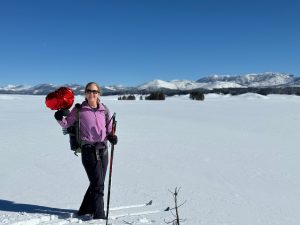
Ashley Gaddis with the red balloon that drifted down from the sky and landed at her feet on Feb. 17, 2024. Photo by Nadia Garbaj
Writing the story, I was sparing in my use of Ashley’s comments to adhere to her wishes. I also use comments from one of our guides to speak to the magic of the transcendent event on Day 3. Yet the story wouldn’t have been complete without Ashley’s voice. I only had a couple of paragraphs of quotations from her; my editor trimmed that to a single sentence. I asked him if we could restore part of what was cut, what I felt was a key phrase feeling connected to loved ones we’ve lost. Like the best editors, he’s thoughtful and open, and agreed to bring back a sentence I felt was essential.
Below is an excerpt. Click here to read the full story on Sierra magazine’s site.
The thermometer had read 8°F just after dawn, and it was still bone-chilling when we’d begun cross-country skiing. Yet here we were, in the dead of winter, near the geographical center of Yellowstone National Park, stripping off our clothes. This wasn’t a crazed reaction to hypothermia—it was a perfectly sane response to arriving at a creek just below a thermal spring, where the water was a perfect 104°.
Sure, we were shivering for a moment as we undressed, but the second we dipped into that creek, with waters warmed from the spring just upstream, we giggled like kids and our hard-working muscles relaxed.
It had been a four-mile ski from our cozy yurt camp through the park’s Hayden Valley to the creek. Every exertion was worth it to soak in that mineral-rich spring. We were among a select few who were overnighting in Yellowstone during a season when far more bison than people inhabit the park.
Our group of six—my wife Jackie, four of her college friends, and I—had skied past a herd of about 40 bison on the way in, their exhalations forming clouds of steam in the frigid air. Trumpeter swans poked their heads into the icy Yellowstone River, seeking bits of food, then honked so sonorously it would have made Louis Armstrong proud.
Skiing was arduous, as this is a natural wilderness without groomed tracks. Our guide broke trail for us. I volunteered to create the grooves for our skis and took the lead but was winded after a few minutes, feeling the elevation (about 8,000 feet) and the effort of compressing the powdery snow.
So the temperate creek was a welcome relief—until we got out. Thankfully, we were warmed to our core. The main challenge was getting dry enough to put on our clothes and pull up our socks. Outfits reassembled and boots in place, we clipped back into our skis and propelled ourselves toward our lodgings, the pastel hues of the distant Absaroka Mountains intensifying in the late-afternoon sun.